The Original Tony
Kert created Tony opposite Carol Lawrence's Maria at the Winter Garden Theatre. His recording of “Something's Coming,” “Maria” and “Tonight” helped establish the musical's sound for generations of listeners.
Larry Kert was the actor, singer and dancer who created Tony in the original 1957 Broadway production of West Side Story, opposite Carol Lawrence as Maria. Their stage partnership helped define one of the great romances of the American musical theatre, and in November 1958 they brought “Tonight” to a national television audience on The Ed Sullivan Show.
More than a decade later, Kert's acclaimed performance as Bobby in Stephen Sondheim's Company earned him a 1971 Tony Award nomination and a unique place in Tony history. This archive follows the much wider career behind those two landmark roles: early film and dance work, Broadway, television, concert appearances, recordings, cabaret and later stage performances.
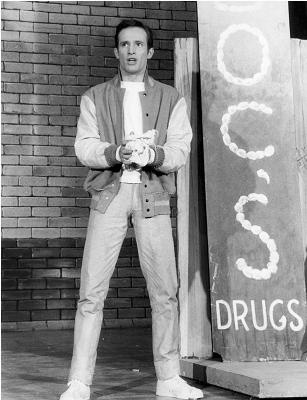
Kert created Tony opposite Carol Lawrence's Maria at the Winter Garden Theatre. His recording of “Something's Coming,” “Maria” and “Tonight” helped establish the musical's sound for generations of listeners.
Kert replaced Dean Jones in Company, became the first—and still the only—cast replacement nominated for a Tony in a competitive category, then took the role to London.
Born on 5 December 1930, Kert grew up in a show-business family. His elder sister, the singer Anita Ellis, became renowned for providing the singing voice for Rita Hayworth and other film stars.
Before becoming a Broadway leading man, Kert worked in films as a stunt man, extra and stand-in. His first professional Broadway credit came in the 1950 revue Tickets, Please!, followed by work as a dancer in ballet and Off-Broadway productions.
While dancing in the chorus of Sammy Davis Jr.'s Mr. Wonderful, Kert was encouraged by his friend and fellow dancer Chita Rivera to audition for a project then known as Gangway—the show that would become West Side Story.
He was not chosen in the first round. But after Stephen Sondheim saw him perform and was impressed, another audition was arranged. Kert auditioned alone and then with Carol Lawrence, and won the role of Tony.
Stephen Sondheim recalled that he and Leonard Bernstein wrote “Something's Coming” in a single day, only days before West Side Story opened out of town. Sondheim said the combination of Tony's character and Kert as the performer was already so vivid that the song came unusually quickly.
Recalling the Washington opening, Sondheim said: “Larry did it on opening night in Washington and stopped the show! He had the audience in the palm of his hand.”
Just over a year after West Side Story opened on Broadway, Kert and Lawrence performed “Tonight” together on The Ed Sullivan Show, preserving for television audiences the chemistry that had made their Tony and Maria such a sensation on stage.
Despite his success on Broadway, Kert was not cast as Tony in the 1961 film. He was told that, at 30, he was not believable as a teenager. Richard Beymer received the role, with Jimmy Bryant supplying Beymer's singing voice. Carol Lawrence likewise did not play Maria in the film.
The decision left the original stage partnership—and its celebrated musical chemistry—as something that belonged uniquely to Broadway.
A selected theatre chronology from Tickets, Please! to Nymph Errant.
A much fuller screen database, including the extensive 1971–77 Tonight Show appearance list.
Surviving performances of “Tonight,” “Maria,” “Being Alive” and television appearances.
The Tony-and-Maria partnership, Ed Sullivan appearance and 1990 Rainbow and Stars reunion.
IBDB, Playbill, Tony Awards, NYPL, Masterworks Broadway, Paley Center and archival photographs.
Kert's identification with Tony was so strong that later career summaries often begin and end with West Side Story. Yet his work extended across Broadway, regional theatre, national tours, cabaret, recordings, television and film. In 1971 Broadway recognised him again when his Bobby in Company received a Tony Award nomination.
Thirty years after West Side Story, he was still earning praise. In 1987 he toured in concert versions of the Gershwins' political musicals Of Thee I Sing and Let 'Em Eat Cake. Washington Post critic Lon Tuck praised the firmness of Kert's sound, the precision of his rhythm and the beauty of his phrasing.
The New York Public Library's Larry Kert papers document that broader career in scores, scripts, photographs, audio, moving-image recordings, programs, correspondence and printed material.
Larry Kert died in 1991 at the age of 60. In its obituary, The New York Times remembered the “big, resonant tenor” with which he had captivated West Side Story audiences for three years in songs including “Tonight,” “Maria” and “Something's Coming.”
Arthur Laurents, who wrote the book for West Side Story, remembered another side of Kert too, describing him as “a California extrovert, laughing, bubbling, deadly funny.” Together, the contemporary recollections capture both the performer and the personality behind one of Broadway's most enduring original roles.